
Implementation and Management of Public–Private Partnerships in Nusantara Capital City
Implementation and Management of Public–Private Partnerships in Nusantara Capital City
Introduction
The development of the new capital city, Nusantara Capital Authority (IKN), has been designed to be fully realised by 2045. To support the successful development of IKN, strategic measures are required - including, among others, the construction of infrastructure. Funding for IKN’s development derives from several sources, one of which is the Public–Private Partnership (KPBU) scheme. Under the latest regulation, Article 1(8) of the Regulation of the head of the Nusantara Capital Authority of the Republic of Indonesia Number 9 of 2025 (Perka OIKN No. 9/2025), a KPBU is defined as a cooperation mechanism between the government and a business entity for the provision of infrastructure for public interest.
This article seeks to outline how this new regulation is intended to provide legal certainty, by strengthening procedural efficiency, accelerating infrastructure development and enhancing investor interest.
This regulation serves as a guideline for the implementation of KPBU within the jurisdiction of the IKN Authority in its capacity as the contracting agency (PJPK), or any official to whom PJPK authority has been delegated. Accordingly, business entities and investors wishing to participate are afforded legal certainty regarding the implementation of KPBU under Perka OIKN No. 9/2025, enabling the IKN Authority to rely on this regulation in preparing, procuring and supervising projects.
The regulation outlines two key components:
(i) The authority of the IKN Authority as PJPK and as the organiser of KPBU for IKN
(ii) The management of KPBU, which may be carried out through KPBU schemes initiated either by the PJPK or by business entities, along with the various investment facilities accompanying such schemes.
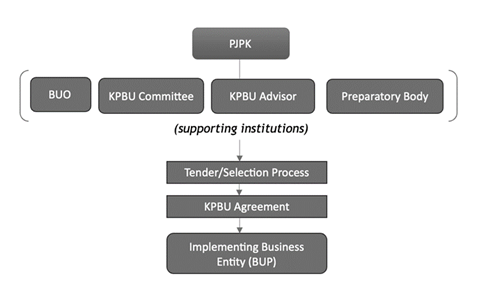
Firstly, the regulation affirms that the Head of the IKN Authority acts as the PJPK for the provision of infrastructure through the KPBU scheme within its jurisdiction. In this capacity, the Head of the IKN Authority may:
• Delegate authority to relevant officials
• Assign the IKN Authority’s Business Entity (BUO)
• Establish a KPBU Committee to assist in all stages of the KPBU
• Appoint KPBU advisors to provide recommendations to the PJPK in the KPBU process
• Be supported by the Preparatory Agency which is intended to provide assistance at the planning, preparation and transaction stages.
The KPBU IKN structure under the PJPK may be illustrated as follows:
Secondly, Perka OIKN 9/2025 comprehensively regulates all stages of the KPBU process, ranging from planning and preparation to transaction and contract implementation. The regulation establishes two types of initiation schemes. Under the PJPK initiated scheme, the IKN Authority identifies and prepares the project from the outset, including determining infrastructure needs, conducting preliminary and full feasibility studies, and preparing complete procurement documents prior to the procurement stage. By contrast, under the Business Entity initiated scheme, projects are proposed by the private sector on an unsolicited basis, with the business entity responsible for preparing the feasibility study and supporting documentation.
To further attract investors, Perka OIKN 9/2025 also provides a range of facilitation measures for the Implementing Business Entity (BUP), including ease of doing business incentives and investment facilities that enable the BUP to obtain streamlined licencing processes and additional supporting access. As a result, KPBU projects in IKN benefit not only from procedural certainty but also from strong investment appeal for both domestic and foreign investors.
Conclusion
Perka OIKN 9/2025 is expected to provide legal certainty and a clear institutional framework for the implementation of KPBU in IKN. By affirming the role and authority of the Head of the IKN Authority as PJPK and by offering two initiation schemes, which are PJPK initiated and Business Entity initiated, the regulation strengthens procedural efficiency, accelerates infrastructure development and enhances investor interest through facilitation measures and investment incentives.
How BDO can help
BDO’s expert legal team applies the practical experience and knowledge gained from working with clients locally and worldwide and can actively assist companies in complying with the above-listed regulations. Please reach out to our partners in BDO Indonesia for further information.
The development of the new capital city, Nusantara Capital Authority (IKN), has been designed to be fully realised by 2045. To support the successful development of IKN, strategic measures are required - including, among others, the construction of infrastructure. Funding for IKN’s development derives from several sources, one of which is the Public–Private Partnership (KPBU) scheme. Under the latest regulation, Article 1(8) of the Regulation of the head of the Nusantara Capital Authority of the Republic of Indonesia Number 9 of 2025 (Perka OIKN No. 9/2025), a KPBU is defined as a cooperation mechanism between the government and a business entity for the provision of infrastructure for public interest.
This article seeks to outline how this new regulation is intended to provide legal certainty, by strengthening procedural efficiency, accelerating infrastructure development and enhancing investor interest.
This regulation serves as a guideline for the implementation of KPBU within the jurisdiction of the IKN Authority in its capacity as the contracting agency (PJPK), or any official to whom PJPK authority has been delegated. Accordingly, business entities and investors wishing to participate are afforded legal certainty regarding the implementation of KPBU under Perka OIKN No. 9/2025, enabling the IKN Authority to rely on this regulation in preparing, procuring and supervising projects.
The regulation outlines two key components:
(i) The authority of the IKN Authority as PJPK and as the organiser of KPBU for IKN
(ii) The management of KPBU, which may be carried out through KPBU schemes initiated either by the PJPK or by business entities, along with the various investment facilities accompanying such schemes.
Firstly, the regulation affirms that the Head of the IKN Authority acts as the PJPK for the provision of infrastructure through the KPBU scheme within its jurisdiction. In this capacity, the Head of the IKN Authority may:
• Delegate authority to relevant officials
• Assign the IKN Authority’s Business Entity (BUO)
• Establish a KPBU Committee to assist in all stages of the KPBU
• Appoint KPBU advisors to provide recommendations to the PJPK in the KPBU process
• Be supported by the Preparatory Agency which is intended to provide assistance at the planning, preparation and transaction stages.
The KPBU IKN structure under the PJPK may be illustrated as follows:
Secondly, Perka OIKN 9/2025 comprehensively regulates all stages of the KPBU process, ranging from planning and preparation to transaction and contract implementation. The regulation establishes two types of initiation schemes. Under the PJPK initiated scheme, the IKN Authority identifies and prepares the project from the outset, including determining infrastructure needs, conducting preliminary and full feasibility studies, and preparing complete procurement documents prior to the procurement stage. By contrast, under the Business Entity initiated scheme, projects are proposed by the private sector on an unsolicited basis, with the business entity responsible for preparing the feasibility study and supporting documentation.
To further attract investors, Perka OIKN 9/2025 also provides a range of facilitation measures for the Implementing Business Entity (BUP), including ease of doing business incentives and investment facilities that enable the BUP to obtain streamlined licencing processes and additional supporting access. As a result, KPBU projects in IKN benefit not only from procedural certainty but also from strong investment appeal for both domestic and foreign investors.
Conclusion
Perka OIKN 9/2025 is expected to provide legal certainty and a clear institutional framework for the implementation of KPBU in IKN. By affirming the role and authority of the Head of the IKN Authority as PJPK and by offering two initiation schemes, which are PJPK initiated and Business Entity initiated, the regulation strengthens procedural efficiency, accelerates infrastructure development and enhances investor interest through facilitation measures and investment incentives.
How BDO can help
BDO’s expert legal team applies the practical experience and knowledge gained from working with clients locally and worldwide and can actively assist companies in complying with the above-listed regulations. Please reach out to our partners in BDO Indonesia for further information.